
The Ocean has long been the home of Pacific peoples, and key to our survival and wellbeing. It is the foundation of our identity, our spirituality and worldview, as well as the source of our sustenance, cultures, economies, food systems, histories, relationships and futures.
It is the pathway that connects our islands and communities. The ocean defines us – We are the ocean; the ocean is within us. Our relationship with the ocean cannot be defined by the resources it provides. Instead, it is our responsibility as guardians to ensure the health and life of the ocean, the lungs of our planet, which is our connection. The health of the ocean and the health of Pacific communities are inseparable.
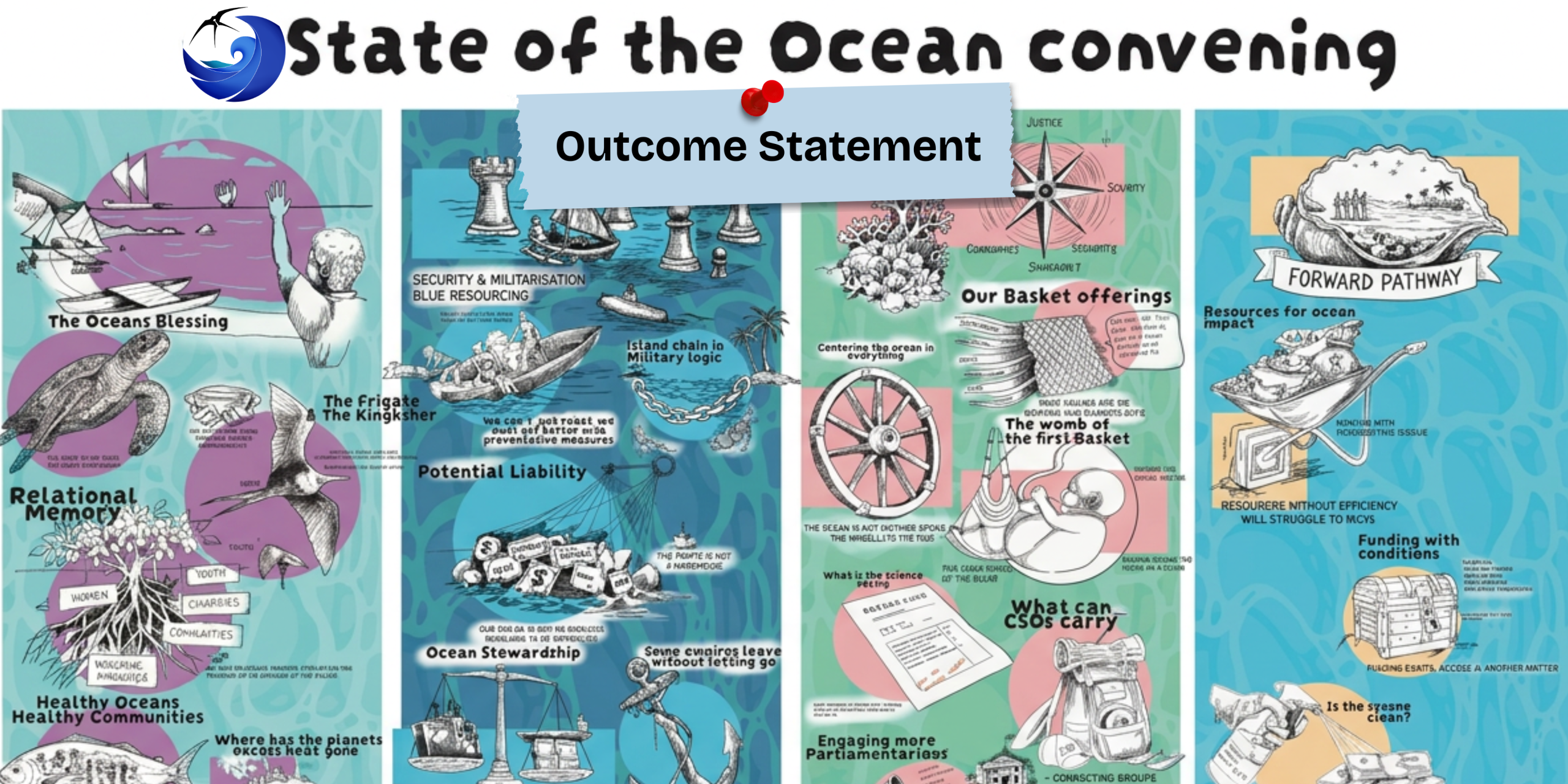
The State of the Pacific Ocean Convening 2026 was a strategic regional CSO-led dialogue centred around governance to address the mounting environmental, economic, and geopolitical pressures threatening the sovereignty and resources of the Pacific region. Held in Suva, Fiji, and anchored in the spirit of World Oceans Day, the gathering provides a platform to address external threats such as climate change, blue economy, pollution, and hyper-militarisation.
In acknowledging the current state of the Pacific Ocean, we therefore:
● call for the recognition of Pacific peoples as custodians of a living ocean, and that Pacific Indigenous spiritualities, epistemologies and methodologies, customary stewardship and cultural relationships with the ocean must be seen as the foundation for all decision-making related to the ocean.
● call on all Pacific cultural and political leaders and governments, development partners, research and technical institutions, faith-based organisations, and civil society organisations to reject false solutions such as deep-sea mining that threaten the health and sovereignty of oceans, and that perpetuate neocolonisation and recolonisation under the guise of security cooperation, climate action and economic development.
● recognise the interconnectedness of Pacific peoples and the issues facing them and call for greater solidarity and coordinated action, rooted in Pacific values and practices, in confronting the challenges posed by climate change, militarisation, biodiversity loss, economic exploitation and deep-sea mining.
● call for the strengthening of Pacific-led research, advocacy, storytelling, arts, media, movements and grassroots mobilisation so that Pacific narratives, voices, and solutions remain at the centre of global conversations on the future of the ocean.
● affirm the value and importance of Indigenous science, practices, and governance in ocean guardianship, also affirming the need to engage the Pacific caucus in regional and international policy spaces and dialogue.
● call for a Pacific future built on peace and demilitarisation, ensuring the region is genuinely nuclear-free and rejects the doctrines of nuclear deterrence, strategic ambiguity, and commit to safeguarding measures that addresses contemporary challenge of aggressive military build-up in the region.
● affirm that the struggle for ocean justice must be inclusive and intersectional, and call for meaningful participation of women, SOGIESC communities, youth, persons with disabilities, and other marginalised groups at all levels of ocean governance, recognising that their knowledge, leadership, and lived experiences are essential to the protection of our ocean and the realisation of Pacific self-determination.
● affirm the expansion of the Pacific Parliamentarians Alliance on Deep Sea Mining (PPADSM) to the Pacific Ocean Leaders Alliance (POLA), as a broader platform and unified voice for Pacific parliamentarians and leaders to engage on ocean issues and to provide greater opportunities for the involvement of other leaders.
● agreed that the State of the Pacific Ocean Convening must be maintained by Pacific civil society, and continue to meet biennially. Vanuatu will host in 2028.