
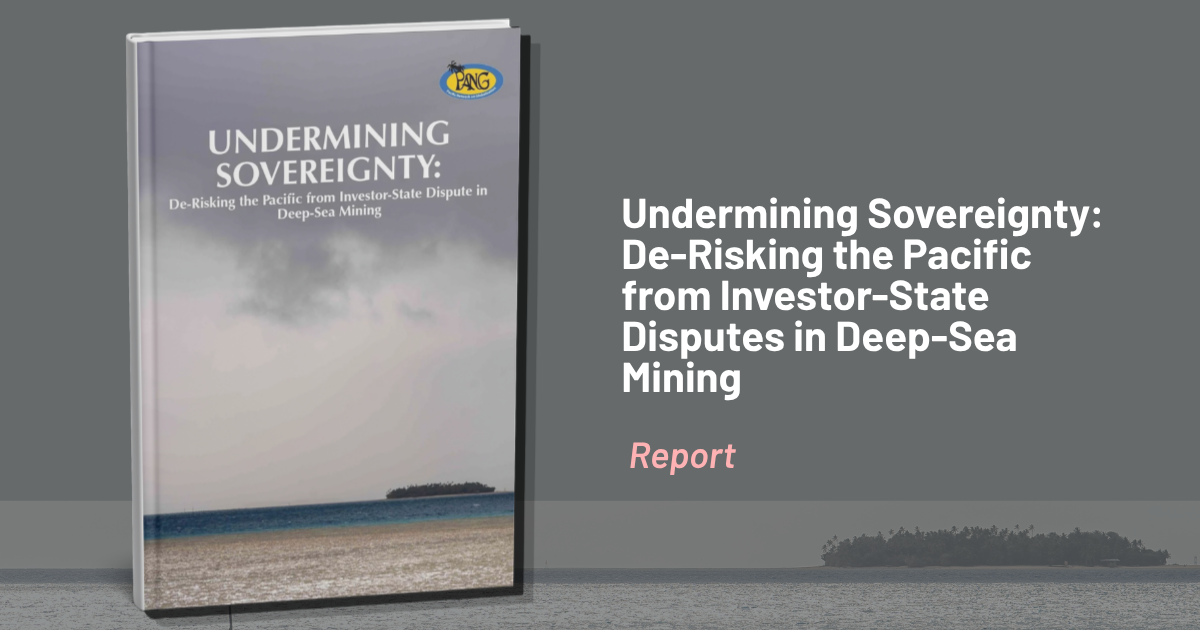
Deep-sea mining (DSM) is increasingly exposing Pacific governments to secretive foreign tribunals that have been used to challenge and overrule government action on climate change and environmental protection in many other countries, according to a new report released today by the Pacific Network on Globalisation (PANG).
“This report highlights the very real and serious challenges that Investor-State Dispute Settlement poses to Pacific sovereignty, a threat we are seeing rise through multiple avenues relating to the push for deep-sea mining,” commented PANG’s Deputy Coordinator, Mr Adam Wolfenden.
Undermining Sovereignty: De-Risking the Pacific from Investor-State Disputes in Deep-Sea Mining, authored by Professor Emeritus Dr Jane Kelsey, unpacks the risks of Investor-State Dispute Settlement (ISDS) and how extractive corporations increasingly use it to sue governments for hundreds of millions of dollars over government actions.
“Mining companies have latched on to ISDS as a way to sue governments that exercise their sovereignty to make laws, policies and decisions in the public interest, but which impact corporate profits. Tribunals hearing disputes are notoriously pro-investor; they operate behind closed doors, and there is no appeal. Not surprisingly, many governments drop their plans in the face of long and expensive lawsuits. Pacific States must not be held to ransom in this way, especially not for something as controversial and speculative as deep-sea mining,” added Dr Kelsey.
The report identifies five pathways through which ISDS commitments are already present or could emerge in parts of the Pacific, including through Bilateral Investment Treaties (BITs), deep-sea mining contracts with private companies, sponsorship agreements for deep-sea mining under the International Seabed Authority (ISA), domestic legislation, and potentially through disputes arising from the United States’ unilateral granting of extraction permits for deep-sea mining.
The increasing use of ISDS commitments in relation to deep-sea mining is creating legal uncertainty for Pacific governments considering whether and how to proceed with the industry.
The report highlights specific risks facing Pacific countries, including Tonga, Nauru, the Cook Islands and Papua New Guinea.
“This report worryingly highlights the exposure that Tonga currently faces through ISDS via bilateral investment treaties, domestic legislation and ISA sponsorship. This creates enormous liability for Tonga regarding its current trajectory on deep-sea mining, leaving the government vulnerable to a dispute if it changes certain laws or cancels DSM contracts because the mining breaches international law,” stated Sesimani Lokotui, Executive Director, Civil Society Forum of Tonga (CSFT).
“What concerns me most is how little the people of the Cook Islands know about the legal and financial risks tied to deep-seabed mining. Private contracts remain hidden from public scrutiny, yet they may allow investors to challenge future decisions made to protect our ocean, our communities and future generations. Cook Islanders deserve to know what commitments have been made in our name. Our government must ensure that investor rights never override our sovereignty, put public money at risk, or limit our responsibility to protect the ocean,” added Sieni Tiraa, Environmental Campaign Manager, Te Ipukarea Society.
While the report discusses several case studies from Papua New Guinea, the secretive nature of ISDS proceedings means formal documents remain closed to the public.
“Papua New Guinea has already experienced the use of ISDS to challenge government decisions on mining leases and deep-sea mining. There is an urgent need to begin the process of removing the threat of ISDS by cancelling the numerous bilateral investment treaties that PNG currently has. The stark lesson about ISDS for the whole region is clear,” commented Samantha Kuman, Coordinator, The Healthy Oceans Network.
As the United States pursues critical minerals by granting permits for deep-sea mining in the high seas without international backing, it is potentially exposing Pacific Island States partnering with companies in this sector, including Nauru and Tonga, to legal uncertainty as the ISA investigates the companies involved. This is complicated further by the United States’ push for Critical Mineral Agreements, which the Cook Islands has signed.
“The issue of ISDS needs to be addressed urgently, especially regarding deep-sea mining, but more broadly as an issue of climate action. The increasing use of ISDS by extractive industries shows that this legal tool is also a climate justice matter,” concluded Mr Wolfenden.
The report is also being formally presented to the Government of Vanuatu in connection with the new Informal Working Group on Investor-State Dispute Settlement for the Transition Away from Fossil Fuels, which will meet in Tuvalu in 2027.
For more information, contact: Jennis Naidu | Media & Communications Manager | Pacific Network on Globalisation (PANG)
Email: communications@pang.org.fj