
"France has breached international and domestic law by conducting the 2021 Referendum without proper consent, violating free, prior, informed consent, attempting to change electoral rules unilaterally, excluding Kanak customary institutions from decision-making, using excessive force and arbitrary detention during the 2024 crisis, and failing to uphold commitments under the Nouméa Accord."
Viro Xulue, Human Rights & Indigenous Law Officer

Media & Communications Manager
communications@pang.org.fj
The question of Kanaky New Caledonia (KNC) remains one of the most complex and unresolved decolonisation processes in the contemporary Pacific. Although framed by key agreements such as the Matignon Accords and the Nouméa Accord, which were intended to guide a gradual and peaceful transition toward self-determination, recent developments suggest that this process is far from complete.
To create a space for reflection and dialogue on the current situation in Kanaky New Caledonia, the Pacific Network on Globalisation (PANG) held a webinar, ‘A Crucial Juncture in Kanaky New Caledonia’ on 25 March 2026, following the recent municipal elections in Kanaky New Caledonia.
2026 Municipal Elections
The two-round municipal elections held on 15th and 22nd March 2026 confirmed a deeply fractured New Caledonia. The Pro-France parties dominated in the capital, Nouméa. Incumbent pro-France Lady Mayor Sonia Lagarde won at the second round of the elections with a staggering 61.99 per cent of the votes, as the Pacific Island News Association (PINA) reported.
President of Women Weaving Peace KNC – Thooyimwâ, Roselyne Makalu, revealed that there was an abstention of votes from Nouméa. The abstention of votes was due to the centralisation of polling stations that were reduced from 56 to eight, as well as there being no availability of public transport in working-class areas on Sunday.
“The right to self-determination is exercised every day by Kanak people. Organising an election while restricting physical access for the most marginalised, the very people who expressed their suffering during the 2024 insurrection, is a form of democratic obstruction,” Makalu stated.
“If indigenous people feel excluded from the polls by administrative decrees, the entire legitimacy of the political process and social peace is put at risk.
“For instance, Inhabitants of Île Ouen (Mont-Dore), located in the South Province, had to travel by boat to Plum village just to cast their vote.”
“However, for the rural and maritime municipalities, Makalu said that the communities mobilised strongly to cast their votes and actively participate in civic life when barriers between the citizens and the ballot boxes are not erected.
As President of Women Weaving Peace KNC, Makalu emphasised that the 2026 Municipal Elections had the highest number of women leading candidacy lists.
“The number of female candidates leading a campaign has nearly doubled, rising from 14 in 2021 to approximately 25.”
‘A Crucial Juncture in Kanaky New Caledonia’
The webinar revealed that with concrete actions and small steps, the path to self-determination of KNC is attainable.
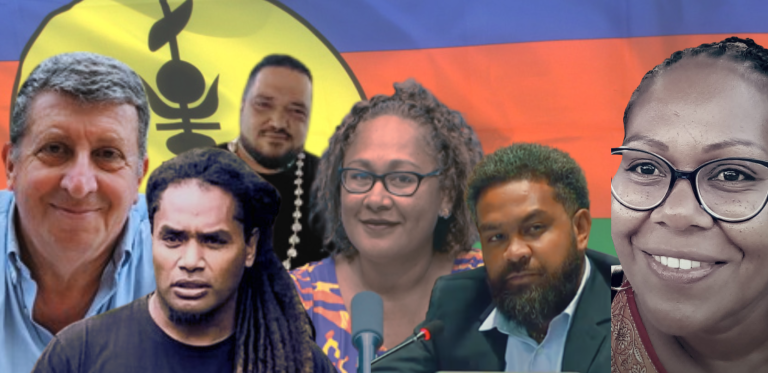
With such challenges and major issues remaining unresolved, PANG’s post-municipal election webinar’s five panellists, from different levels of leadership, brought together legal analysis, political developments, and lived experiences, offering interventions for the self-determination of KNC.
Kanak Youth Feel Abandoned
Teva Avea, an activist and civil society representative who played a crucial role during the 2024 unrest in securing negotiations between the youth and communities, noticed that the inequalities have risen in the working-class neighbourhoods of Nouméa since the 2024 riots.
Avea, who resides in Tuband District, considered a working-class neighbourhood in KNC, has felt these inequalities firsthand. He said that the results of the recent municipal elections indicate that the future of the neighbourhood remains bleak.
“We are feeling abandoned, we no longer have public transport, and the institutions have also abandoned the neighbourhoods, in terms of infrastructure and community centres that address youth problems are either closed or not open during significant hours.
“The Population in the northern districts had to travel 7 km to vote, as there is no longer any mode of public transport in these neighbourhoods.
“We clearly understand that there is a political agenda to maintain this inequality, to keep a foot on the leaders of the Kanak and Oceanian population. That is the consensus of the population living mainly in these neighbourhoods.”
Avea concluded his intervention and called for urgency from the French State for the territory to progress to make its own institutional decisions as mandated, without further political hindrances.
“The decisions of the institutional future of the country need to take place here in Kanaky New Caledonia and no longer 22,000 km away in mainland France.”
Decolonisation is Incomplete
Human Rights and Indigenous Law Officer, Viro Xulue, shared his legal analysis on how the decolonisation of New Caledonia is an ongoing international legal obligation of France that remains incomplete and not properly fulfilled.
“Kanaky New Caledonia remains in the United Nations (UN) list of Non-Self-Governing territories, meaning that France retains an international obligation to ensure the full realisation of the Kanak people’s right to self-determination,” Xulue added.
“France has breached international and domestic law by conducting the 2021 Referendum without proper consent, violating free, prior, informed consent, attempting to change electoral rules unilaterally, excluding Kanak customary institutions from decision-making, using excessive force and arbitrary detention during the 2024 crisis, and failing to uphold commitments under the Nouméa Accord.
Viro said that the 2024 uprising rekindled colonial trauma, bringing to light an alarming social and human situation that France had long ignored, both domestically and internationally.
“France is legally required to respect Kanak self-determination, ensure free, prior, informed consent, include indigenous institutions in decision-making, and allow impartial international oversight.”
Coloniser-Colonised Relationship
Oriane Trolue, child of the Apishö clan, in the Kingdom of Lössi in Drehu country, focused on the necessity of deconstructing the mechanisms of domination in the current political process and the indispensable role of women in the governance structures in the territory.
Serving as a political bureau member of the Kanak and Socialist National Liberation Front (FLNKS) and activist for the movement of pro-independence Oceanians, Trolue stated that this is more than a political negotiation; it is a struggle against an entire system of French domination.
“We see that the French State, instead of working on a win-win agreement with the indigenous people, chooses to maintain a colonialist method and approach,” she highlighted.
“The relationship between the French State and New Caledonia remains that of coloniser-colonised. The decolonisation process is unfinished and suffers from distortion, but also from a whole arsenal of colonialist assaults, political, legal, as well as media and military.”
“Being in a colonial relationship, it is important to remedy the asymmetry that exists due to the colonial fact. So, we must reach a dialogue where we know exactly whether the rebalancing has been achieved; if it hasn’t, to what extent. We need a truly real and detailed assessment of the colonisation.”
A Future Claimed, Not Given
Guillaume Vama, who describes himself as a ‘young Kanak’, resides in the south of New Caledonia. Being detained as a political prisoner in France in 2024, he is no stranger to the attempts of the French authorities to maintain sovereignty over the territory.
Vama further reiterated that the events that led up to the uprising in May are a continuity from the 1980s, of the French State and Macron Government wanting to silence the Kanak people, remove the idea of independence from the youth, and deter the territory from reaching full sovereignty.
“I think on the day of the uprising, the youth finally said ‘no’, and mobilised in the hopes of defending our culture, our identity,” he expressed.
Vama is calling on the region to help provide concrete actions to support the territory in the preservation of our culture and the development of our territory, and
“Young people were at the heart of the events; they expected concrete perspectives for integration and consideration. Without action, the social gap will continue to widen.
“We need investors, and we need to fund and train young people directly into entrepreneurship. These young Kanak youth need to be able to develop their own land through agriculture, fishing, alternative sustainable development systems like aquaculture, and local initiatives that respect the environment and traditions, while attracting investors.
“With this economic crisis we are facing today, and the relaunch of tourism, there is a clear desire from the population to be able to create economic development for themselves.
“I want them to feel that they are coming to Kanaky, they are coming to experience our culture, and not just stay in luxury hotels.”
Uncertainty Grows Ahead of Elections
Islands Business (IB) Magazine correspondent and French in the Pacific expert, Nic Maclellan, who introduced the political landscape of the overseas territory post-Bougival Agreement, said the French Presidential Elections must be held in May next year as mandated in the French Constitution.
“President Macron, who has very poor opinion polling, now faces serious problems getting policies through. If Bougival does not succeed, then there may not be an agreement until people decide who the next French president is, who they are dealing with.”
This uncertainty is heightened by the upcoming June 2026 legislative elections in New Caledonia and the May 2027 French presidential election, which could reshape the political landscape and delay any final agreement.
Maclellan stated that the economic, social, and cultural impacts on indigenous Kanak and other poor people from other communities are in a very difficult economic situation.
“There are global implications from the war against Palestine, against Lebanon, and against Iran that will affect tourism, will affect energy prices, and will affect food production.
‘Bougival is Dead’
The Union Calédonienne (UC) President Emmanuel Tjibaou, declared that ‘Bougival is dead’.
Almost a week after the municipal elections, on April 02, 2026, France’s Assemblée Nationale had rejected the government’s proposed constitutional Bill to reform the status of New Caledonia, without debate, in a 190–107 vote in the French legislature. The resolution to reject the text was proposed by Tjibaou.
This rejection came after two previous reform attempts that had sparked deadly riots in the archipelago, killing 14 people and plunging the local economy into crisis.
The Constitutional Reform Bill aimed to replace the 1998 Nouméa Accord and implement the outcomes of the Bougival Agreement (July 2025) and the Élysée–Oudinot Agreement (January 2026).
To achieve this, the government put forward legislation to implement two political agreements drafted by the French State with five of six New Caledonian parliamentary groups: the July 2025 Bougival Accord and a supplementary text adopted in Paris in January this year, known as the Elysée-Oudinot Accord.
However, both texts have been rejected by the main independence coalition, Front de Libération Nationale Kanak et Socialiste (FLNKS). After adoption by the French Senate in February, the legislation was criticised by a range of political parties in the lower house.
A Future Defined by Hope
The future of KNC remains uncertain and continues to be shaped by ongoing struggle and support from across the region. In response, the PANG and the Pacific Conference of Churches (PCC) brought together a Pacific Peoples’ Mission in April 2025 to engage in cultural exchange and pastoral visits with communities most affected by the events of May 2024 in KNC.
The Pacific Peoples’ Mission to Kanaky New Caledonia report presents the mission’s findings, offering a rapid assessment of the situation on the ground. It aims to amplify the voices and lived experiences of affected communities while supporting the broader aspirations for self-determination among the Kanaky people.
Kanaky New Caledonia’s future remains uncertain, but as the report highlights, it is the voices and lived experiences of affected communities that continue to shape the struggle for self-determination. In the spirit of Kanak resistance and identity, as often expressed in independence discourse, “our land, our culture, and our people cannot be separated, and we will not be reduced by what we endure.”