
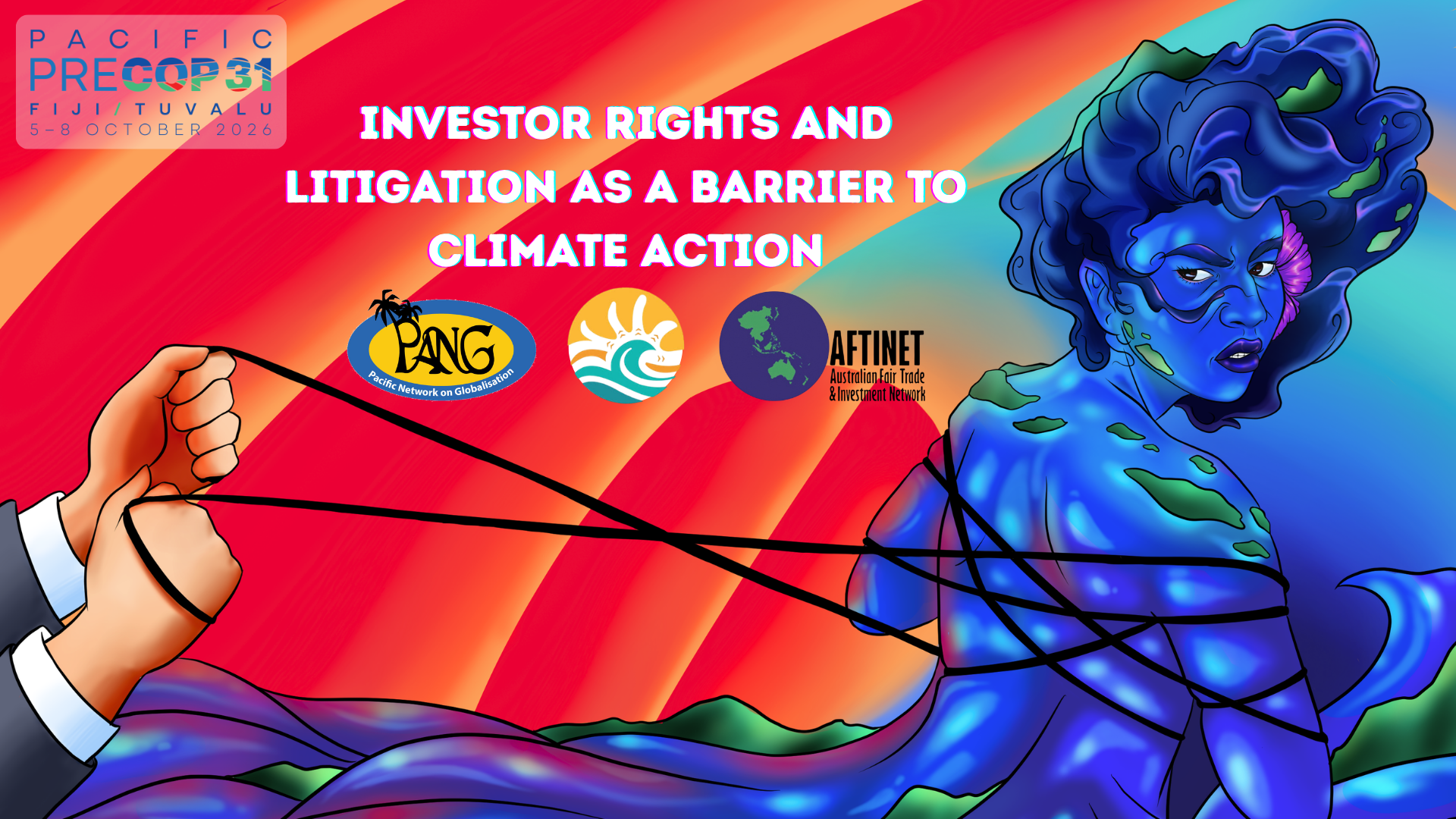
For Pacific countries on the frontlines of climate change, the action needed to protect their oceans and communities is increasingly colliding with the legal rights of foreign investors, as deep-sea mining and other extractive industries seek protections that may constrain future government responses.
The warning was raised at a Pacific Pre-COP31 stakeholder event, “Investor Rights as a Barrier to Climate Action,” convened by the Pacific Network on Globalisation (PANG), the Australian Fair Trade and Investment Network (AFTINET) and the Pacific Islands Climate Action Network (PICAN).
The discussion brought together international experts to examine how investment treaties, private contracts and arbitration mechanisms, known as Investor-State Dispute Settlement (ISDS), can expose governments to costly legal claims when they introduce measures to protect communities, the environment and the climate.
For the Pacific, PANG Deputy Coordinator Adam Wolfenden said the emerging deep-sea mining industry presented a particular concern, given its potential environmental impacts and the regulatory uncertainty surrounding the industry.
“Deep-sea mining is not a climate solution. It will disrupt the climate-regulating systems of the ocean, including carbon sinks.”
“For an industry that is untested and under-regulated, we do not know what the regulatory changes will be, but there will be changes. That sets Investor-State Dispute Settlement (ISDS) up as the perfect vehicle, or the perfect home, for deep-sea mining.”
He said ISDS protections were appearing through multiple channels, including investment treaties, private contracts, International Seabed Authority (ISA) sponsorship agreements and domestic deep-sea mining legislation.
International Policy Lead at PICAN, Dr Sindra Sharma, said the issue extended beyond deep-sea mining, with ISDS increasingly creating tension between governments’ climate obligations and investor protections.
“We see two systems that are pulling in opposite directions. We have international climate litigation, and all the Pacific states have taken climate obligations to the highest courts in the world,” she stated.
“On the other side, we have investment arbitration…where investors use bilateral treaties, free trade agreements and different charters, including the Energy Charter Treaty, to challenge the very measures that governments are taking.”
Dr Sharma said the conflict was particularly significant as governments face growing pressure to phase out fossil fuels and meet the 1.5°C climate target.
“Existing coal, oil and gas infrastructure has to immediately cease, and those regulatory acts, coal phase-out deadlines, extraction moratoriums, permit revocations, and others, are now subject to investor claims. That is where the danger comes in.”
Dr Jane Kelsey said the potential scale of investor claims could place significant financial pressure on governments seeking to strengthen climate policies.
“Agreements and contracts can sometimes be used in offshore, private arbitration. These proceedings are not conducted like a normal court judgment. They are often conducted in secret, and sometimes the existence of a dispute is not even known,” Dr Kelsey stated.
“That, not surprisingly, has what we call a chilling effect on government climate action.”
The potential for large claims also has implications for governments’ ability to finance climate action, with damages for anticipated future profits potentially diverting public resources.
Dr Patricia Ranald, AFTINET Convener, highlighted Australia as an example of how community campaigns can influence government policy on ISDS.
She said community opposition helped prevent ISDS provisions from being included in the US-Australia Free Trade Agreement and contributed to Australia adopting a policy of excluding ISDS from new trade and investment agreements.
However, she warned that the mechanism continues to be used by fossil fuel companies and investors seeking compensation from governments.
“It is a real threat to democracy because they are bypassing community resistance and court decisions.”
The panel called for greater action to remove exposure to ISDS, including from investment agreements, private contracts, and DSM, as well as to engage in international processes, like COP and the Transition Away from Fossil Fuels, for coordinated global action in response to this threat.