
by Tania Uale
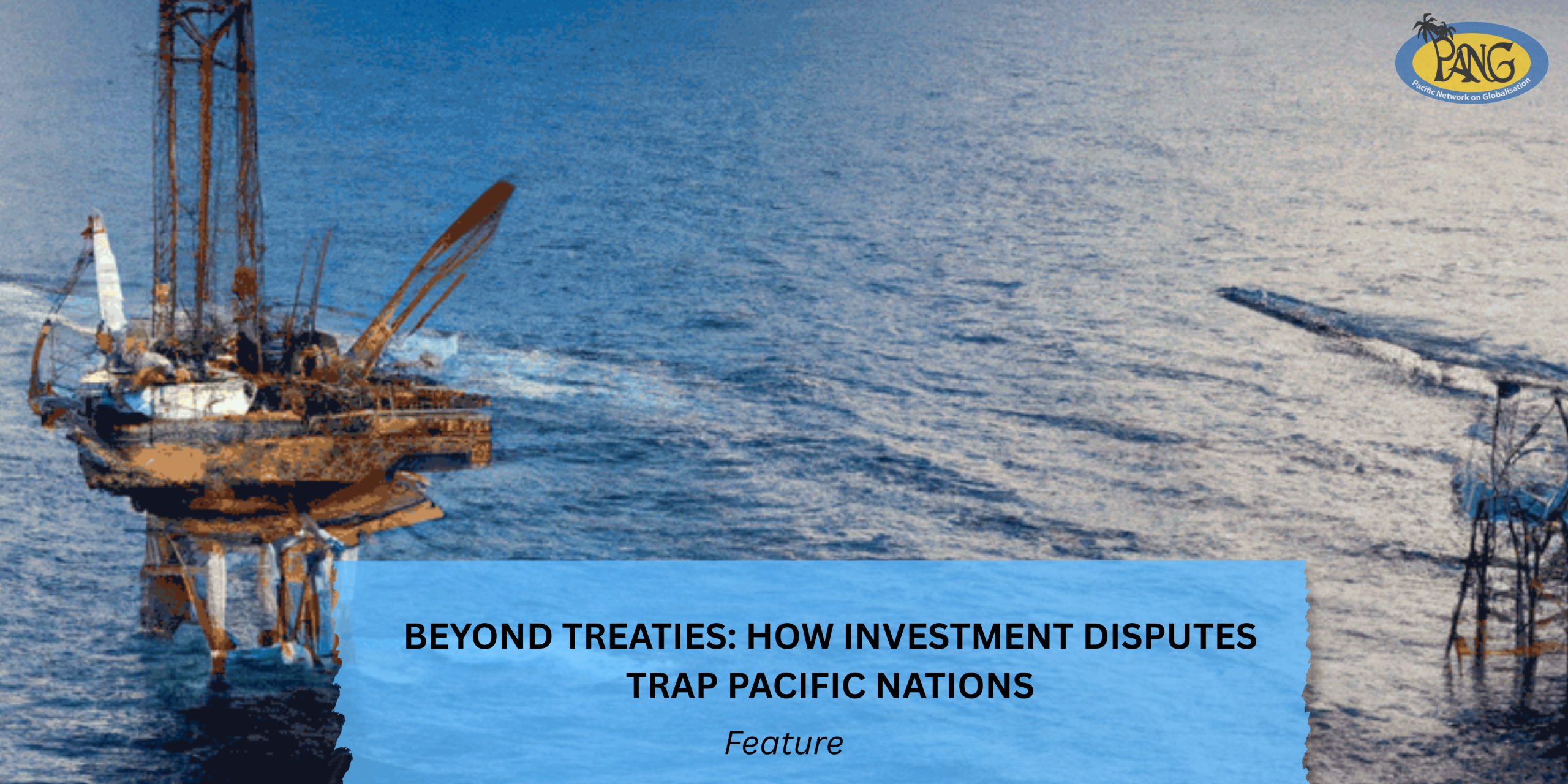
Across the vast expanse of the Blue Pacific, island states are managing approximately 30% of the world’s oceans and seas within their exclusive economic zones (EEZs), making the region a continent of “Big Ocean States”.
What lies in the depths of these waters are substantial deposits of rare earth elements and precious minerals. These deep-sea minerals have become the centre of regional to international debate, driven by the increasing demand for energy, military expansion, and digital and commercial technologies. Corporations have now entered a race to secure access to Pacific earth minerals.
The Pacific region is not new to public discourse on the depletion of ecological resources, destruction of marine livelihoods and cultural loss; however, foreign mining corporations are establishing legal rights that will allow them to bypass domestic courts and settle disputes before offshore arbitral tribunals through Investor-State Dispute Settlement (ISDS).
Dr Jane Kelsey, former professor of Law at the University of Auckland, who recently authored the report Undermining Sovereignty: De-Risking the Pacific from Investor-State Dispute in Deep-Sea Mining, argues that global geopolitical drivers are to blame for this rush to the bottom of the ocean.
The report demonstrates that the lack of formal Bilateral Investment Treaties (BITs) with foreign investors exposes Pacific nations to substantial risk of multi-million or multi-billion-dollar international arbitration claims through alternative legal pathways.
Understanding Arbitration: Public Courts vs. Offshore Tribunals
To understand the threat of ISDS, we must examine contrasting domestic court systems with the international investor-state arbitration tribunals. Domestic Judicial Systems are typically settled in public courts by tenured judges who must balance commercial interests against public health, environmental regulations, human rights, and community welfare while adhering to national constitutions and Kastom law.
Contrarily, ISDS cases are privately settled behind closed doors by ad hoc commercial tribunals, such as the World Bank’s International Centre for Settlement of Investment Disputes (ICSID) or under United Nations Commission on International Trade Law (UNCITRAL) rules.
ISDS panels consist of private commercial arbitrators, such as investment lawyers who alternate roles in representing corporate entities and arbitrators. The flaws within ISDS are structural and deeply rooted to the system. Foreign mining companies are protected by enforced, broadly termed investor protections such as “Fair and Equitable treatment” (FET), “legitimate expectations”, and protection against “indirect expropriation”.
Adam Wolfenden, Deputy Coordinator of the Pacific Network on Globalisation (PANG), stated in the report’s official launch that the system is fundamentally structural in its bias.
“The mechanism itself is very much tilted towards the company and against the state, and this idea that the state and the communities have the right to determine for themselves what the economic trajectory and regulations are and how to uphold their environmental protections and human rights.”
Sieni Tiraa Ivaiti, Environmentalist Campaign Manager at Te Ipukarea Society (TIS) in the Cook Islands, highlights how this would affect state regulatory authority.
“As we have seen recently here in the Cook Islands, company structures and ownership can change. Ultimate ownership and control are not always clear. Important contracts, agreements, and legal documents aren’t accessible either,” she said.
“This makes it extremely difficult for the Cook Islands public and civil society to understand who holds the rights, who carries the liabilities, and what legal and financial risks our governments may have accepted.”
The cautionary tale of Solwara 1 and Papua New Guinea’s K3000 Million loss
Papua New Guinea (PNG) faced the devastating real-world consequences of ISDS with Nautilus Minerals over the Solwara 1 project in the Bismark Sea.
In 2011, Canadian-listed Nautilus Minerals Niugini LTD was granted the world’s first commercial deep-sea mining license. Local coastal communities strongly opposed this project, fearing the destruction of hydrothermal vents, impact on fisheries due to mineral leaching and severe cultural disruption. When the PNG Government hesitated to complete equity financing, Nautilus initiated international arbitration in Sydney, Australia, in 2013 under UNCITRAL rules.
PNG was forced into a compromised settlement after being ruled against by the arbitrator. In order to fund a forced 15% equity stake, PNG took out a 375 million Kina (approximately USD 120 million) bank loan through a state enterprise without prior approval from parliament.
Nautilus saw its collapse into bankruptcy in 2019, leaving the project abandoned, PNG as an unsecured creditor and the loss of more than 300 million Kina in public funds PNG had invested.
Samantha Kuman, Interim National Coordinator for The Healthy Oceans Network (THON) in PNG, expressed the costly impact of the failed project during the launch.
“Almost every single person in the country existing at that time paid 41 Kina each. For some people, that might be a chump change. For some, that is way above their daily living allowance,” added Kuman.
“Prevention is cheaper than arbitration, and sovereignty is more valuable than a long-term investment promise,”
Despite the project’s collapse, Deep Sea Mining Finance Ltd, a private company registered in the British Virgin Islands acquired the licenses and resumed sampling in 2024. Any future cancellation by PNG could potentially lead to another ISDS lawsuit under the UK-PNG Bilateral Investment Treaty (BIT).
The Five Legal Pathways to Corporate Litigation
While Bilateral Investment Treaties (BITs) that contain ISDS provisions is a common avenue for countries to get sued by foreign companies, this is not the only mechanism for countries to be exposed to such liability.
Dr Kelsey identified five legal pathways through which foreign mining investors can initiate ISDS proceedings in the report.
First, legacy BITs often grant direct enforceable rights through international arbitration. Not just this, even if these treaties are terminated, PNG’s legal BITs with Australia, Germany, China and other countries can continue to protect foreign investors’ rights for up to 20 years after a state terminates the treaty.
Second, State-Investor Contracts often contain “stabilisation clauses.” These clauses restrict a government’s ability to change taxes, royalties, and environmental regulations and allow disputes to be taken to international arbitration.
Third, International Seabed Authority (ISA) Sponsorship Agreements create a legal pathway; through this, private firms must acquire state sponsorship in order to explore international waters known as “the Area”. Signed agreements between Pacific nations such as Tonga, the Cook Islands and Naoero and the subsidiaries of The Metals Company (TMC), including Tonga Offshore Mining Limited (TOML) and Nauru Ocean Resources Inc. (NORI), provide investors with ISDS legal protections and litigation pathways if they believe the state’s action breaches the agreement, including changes to Tonga’s deep-sea mining legislation.
Fourth, domestic Seabed Mining Acts in the case of Naoero and the Cook Islands allow disputes to be taken to international arbitration instead of being settled through domestic courts. These statutory pre-commitments allow this to happen and raise questions about sovereignty and who gets to decide on the implementation of domestic law.
Finally, the report further discusses the US Deep-Seabed Extraction Permits, which unilaterally allow mining companies to apply for permits to extract minerals from the seabed in international waters. Companies such as The Metals Company (TMC) USA and American Ocean Minerals Corporation (AOMC) are seeking these US permits that may overlap with zones approved by the ISA. This could create legal disputes with Pacific nations under international law.
The “Chilling Effect” and Community Opposition
The case of Odyssey Marine Exploration v United Mexican States (2024) demonstrates how deep-sea mining companies use international arbitration to challenge government decisions as well as sideline community perspectives.
When the Mexican Government rejected the company’s environmental assessment, Odyssey took legal action and filed a claim under the North American Free Trade Agreement, arguing that the state government had harmed its investment. The tribunal granted the mining company a handsome USD 37 million in compensation, in the process of which it refused to allow the voices of a local fishing cooperative, affected by the proposed mining, to be considered in its decision. This case shows how ISDS undermines the ability of governments to respond to community concerns as a legitimate reason for decision-making. Cook Islands are at potential risk of international arbitration as Odyssey has a majority stake in Cook Islands Cobalt Limited and equity in Moana Minerals Limited, both of which have exploration licenses in the EEZ.
Dr Kelsey explained that the “chilling effect” is generated by asymmetrical legal exposure: “by having ISDS threatening to use it, or even having officials aware of it, they can scare the state from going through with a proposal that the investors oppose.”
Olive Mafi, Program Coordinator for the Civil Society Forum of Tonga (CSFT), explained how these legal structures can limit communities’ ability to take part in democratic decision-making.
“Dialogue after dialogue, the overwhelming majority of those people who had taken part in this discussion said no to deep-sea mining,” Mafi stated.
“Agreements of this kind can put a price on a government changing its mind, and our people have never been shown what that price might be. A sovereignty we cannot afford to use is not really sovereignty.”
This opacity is particularly evident in the Cook Islands, where the US-based Odyssey Marine Exploration is tied to joint ventures alongside the state-owned Cook Islands Investment Corporation (CIIC) through entities holding seabed exploration licenses in the nation’s EEZ.
However, the agreements between the state and investors, including sponsorship contracts, remain confidential; the public and local communities are not fully aware of the government’s potential financial obligations and exposure to investor-state arbitration.
De-Risking Pacific Sovereignty
There is a growing global opposition to ISDS as it undermines the sovereignty of countries and is increasingly being used by extractive industries, including to challenge climate action.
Undermining Sovereignty: De-Risking the Pacific from Investor-State Dispute in Deep-Sea Mining’s policy roadmap highlights five key recommendations to protect national budgets, public resources and ocean governance. Countries such as PNG, Tonga and Timor-Leste should terminate active BITs and remove “survivor clauses” that allow investor protections to remain in force after a treaty is terminated.
The Pacific region must also ensure that ISA sponsorship agreements preserve the right to handle disputes through domestic courts and prioritise national laws. Lastly, to uphold legal and environmental compliance standards, Pacific states must re-examine seabed sponsorship contracts and eliminate investor-state arbitration clauses.
Tania Uale is a final-year journalism student at the University of the South Pacific. She is currently an intern at the Pacific Network on Globalisation (PANG).
For more information, contact: Jennis Naidu | Media & Communications Manager | Pacific Network on Globalisation (PANG) | Email: communications@pang.org.fj