
"We urge leaders to recommit to the MSG’s Udaune Declaration position on deep-sea mining, to translate regional commitments into binding domestic legislation, consider a regional moratorium on DSM exploration and exploitation, and strengthen cooperation toward a unified Melanesian and Pacific approach."
Pacific Network on Globalisation (PANG) Coordinator, Joey Tau
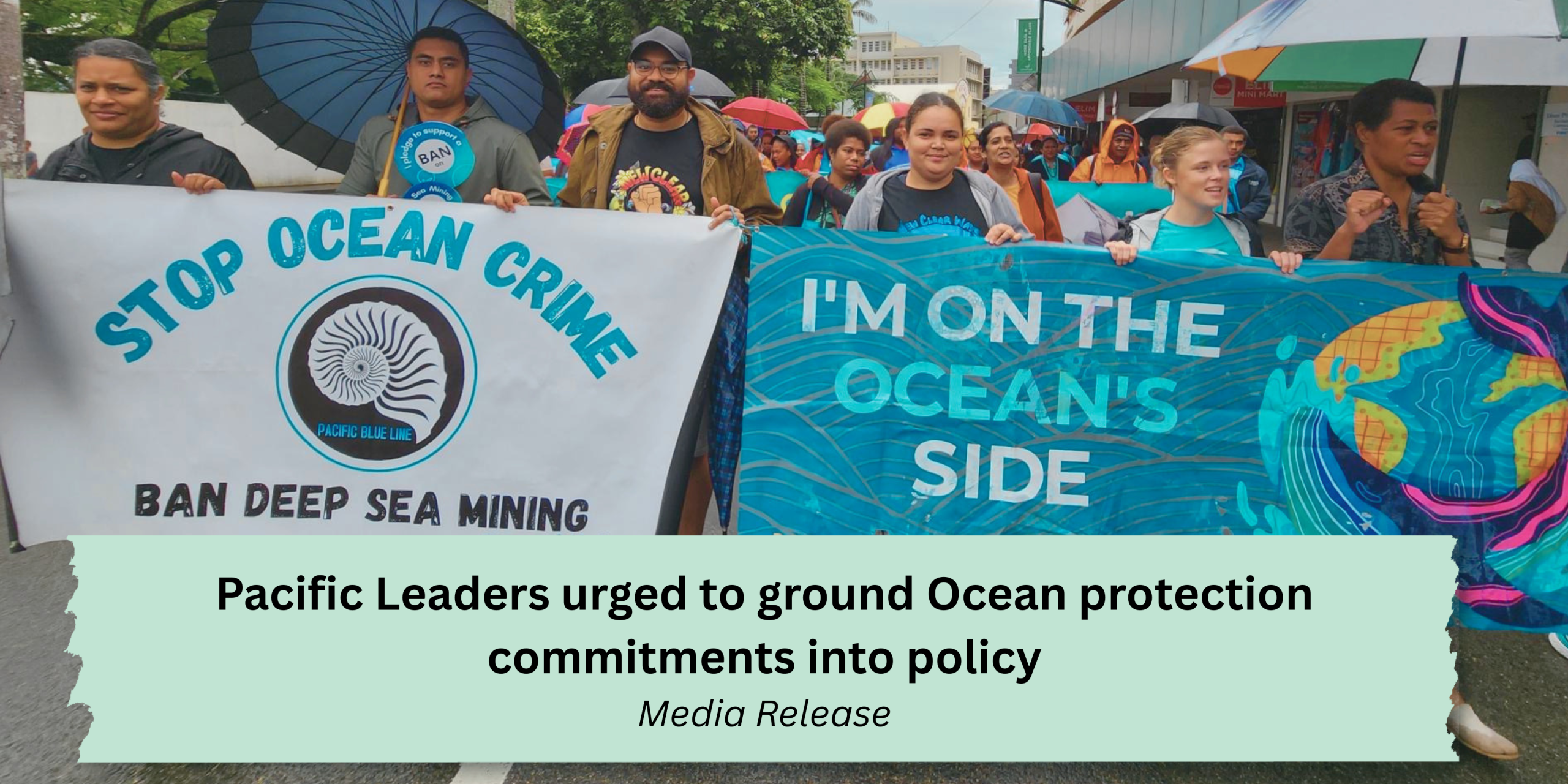
As Pacific leaders conclude the inaugural Melanesian Ocean Summit in Papua New Guinea (PNG), civil society is calling for urgent action to turn ocean commitments into enforceable national laws, particularly on deep-sea mining (DSM), where concerns over environmental impacts continue to grow.
The Pacific Network on Globalisation (PANG) and partners have today released a legislative and policy review that stresses that regional and international pledges by Melanesian Spearhead Group (MSG) countries, and the extended region, must be backed by strong domestic legal frameworks to ensure they are implemented in practice, rather than remaining statements of intent.
PANG Coordinator, Joey Tau, is calling on Pacific Leaders to strengthen and expand commitments, particularly the call for a moratorium on deep-sea mining.
“We urge leaders to recommit to the MSG’s Udaune Declaration position on deep-sea mining, to translate regional commitments into binding domestic legislation, consider a regional moratorium on DSM exploration and exploitation, and strengthen cooperation toward a unified Melanesian and Pacific approach,” Tau stated.
“A renewed and expanded commitment to the Udaune Declaration could position the Pacific at the forefront of global ocean governance and help safeguard marine ecosystems for future generations.”
Drawing from the International Court of Justice’s landmark Advisory Opinion (AO) in July last year, the policy review challenges Melanesian Leaders to revisit their commitments under the Udaune Declaration of 2023, to ensure national policies on ocean protection in relation to deep-sea mining are in place to ground the moratorium stance.
“As talks continue at the International Seabed Authority (ISA) on establishing a Mining Code, there is an even greater need to adopt a precautionary approach. The guidance from the ICJ reinforces this as it affirms states must take ‘as far-reaching and efficacious as possible’ measures to protect the marine environment.” Tau further added.
These developments are strengthening calls for clearer domestic legislation, including moratoriums, as evidence of compliance with international obligations. However, implementation among Udaune Declaration signatories remains uneven.
Echoing similar concerns, Deputy Director of the Social Empowerment and Education Program (SEEP), Joe Ravea, stressed that Pacific leaders must close the gap between regional commitments and national implementation.
“We need robust, comprehensive policy and legislative pathways established immediately to safeguard our ocean from the irreversible impacts of deep-sea mining,” Ravea said.
Across Melanesia, countries are at different stages of translating commitments into law. In Kanaky New Caledonia, legislation prohibits all exploration and exploitation of seabed mineral resources for a period of 50 years within its maritime jurisdiction.
While Fiji and Solomon Islands have demonstrated political will through proposed moratoriums, comprehensive legal frameworks are still being developed.
In Papua New Guinea, a moratorium on aspects of deep-sea mining was proposed in 2019 by Prime Minister James Marape, but has failed over time to translate such a commitment into national policy.
PNG Healthy Oceans Network Coordinator, Rosa Koian, said, “We are also aware of potential interests to mine the seafloor; however, we strongly support our prime minister in not allowing deep-sea mining in the country.”
“The defunct Nautilus Minerals Solwara 1 project has already cost PNG millions of kina, and we cannot afford to repeat that mistake. Deep-sea mining is not a sound investment, and PNG and other Pacific Leaders must prioritise caution and stronger safeguards when speaking about ocean governance.”
The Vanuatu Indigenous Land Defence Desk (VILDD) shares similar concerns, adding that it is about time Pacific Leaders put grandstanding commitments into action to assert Ocean guardianship in practice against current and arising threats.
For more information, contact: Jennis Naidu | Media & Communications Manager | Pacific Network on Globalisation (PANG) | Email: communications@pang.org.fj